Download this essay as a PDF
Thirteen pages: the three-month scorecard for all nine companies from the July piece, what record earnings and falling share prices tell us about how the market is pricing the memory cycle, what I got wrong, and the earnings calendar to watch.
⬇ Download PDF (537 KB, 13 pages, 3 figures)
On 2 July I wrote that the pullback in memory and storage stocks was "the entry point, not the exit." I opened with the California gold rush and the observation that the people who reliably got rich were the ones selling picks and shovels, and I spent most of the piece arguing that SanDisk and Western Digital were the picks and shovels of the AI buildout — that the memory shortage was real, that earnings were compounding as fast as the share prices, and that the 1 July sell-off was profit-taking rather than a broken thesis.
Three months is not long enough to judge an investment thesis. It is long enough to judge a call about an entry point, and I said I would come back to it. So here is the scorecard, written with the same data-first approach as the original, including the parts that do not flatter me.
The short version: the shortage held, and the trade didn't. Almost every fundamental claim in the July piece was confirmed — in several cases by a wider margin than I expected. And the two stocks at the centre of the piece are down 22% and 34%.
1. The scorecard
If you had put an equal amount into each of the nine companies at the 1 July close, you would be down 5.6% as of Friday. Over almost the same period — measured from the 2 July close, the nearest I could source — the VanEck Semiconductor ETF (SMH) is up about 1.9%. The basket underperformed the sector it was meant to be the sharpest expression of.
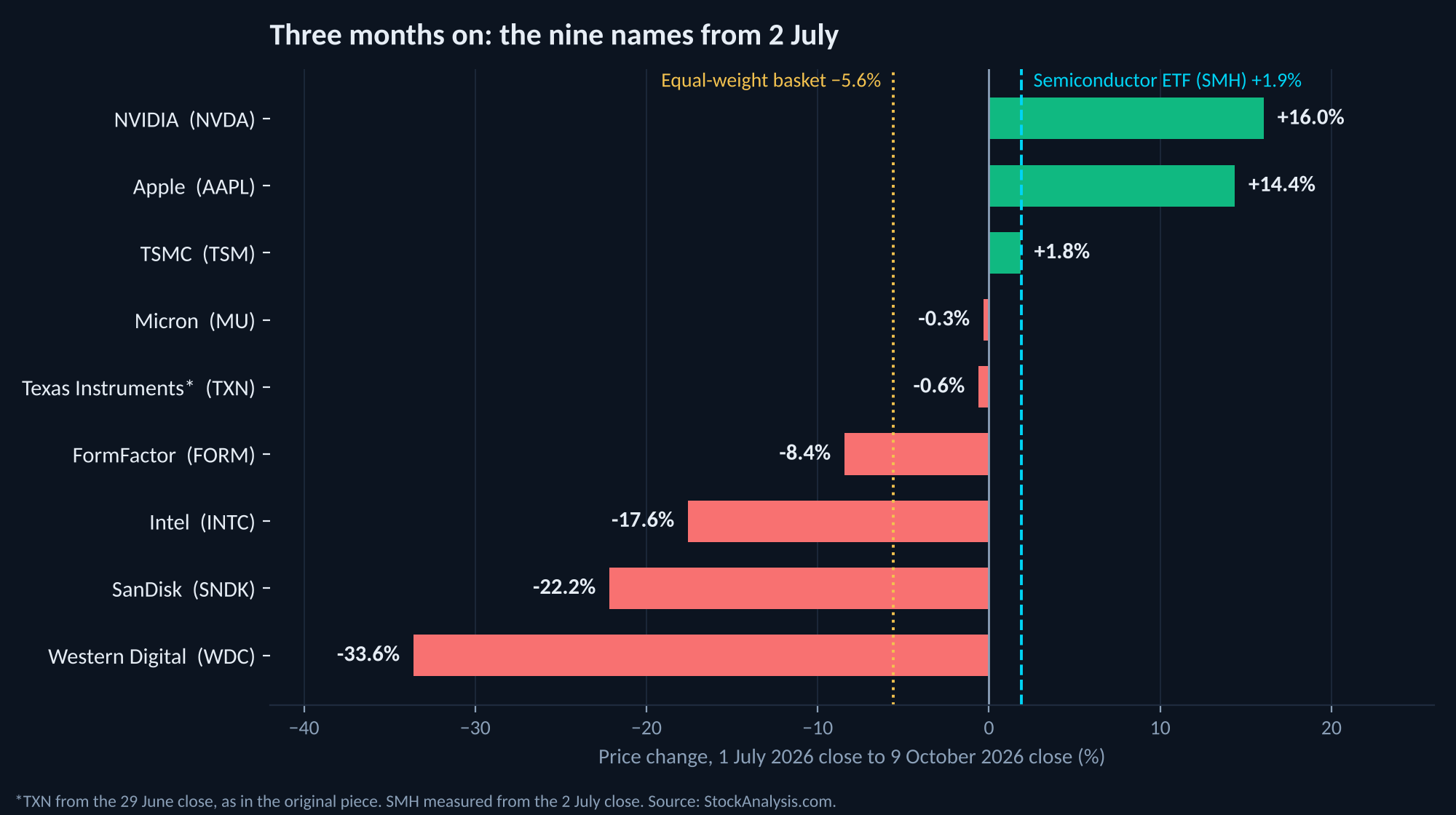
Price change from the 1 July close to the 9 October close. The best two performers are the two names the July piece was least enthusiastic about; the worst two are the two it was built around.
| Company | Ticker | 1 Jul close | 9 Oct close | Change | Avg. target then | Avg. target now | Implied upside now |
|---|---|---|---|---|---|---|---|
| NVIDIA | NVDA | $197.58 | $229.28 | +16.0% | $301.62 | $328.72 | +43% |
| Apple | AAPL | $294.38 | $336.64 | +14.4% | $315.09 | $328.09 | −3% |
| TSMC | TSM | $445.12 | $453.31 | +1.8% | $487.56 | $578.22 | +28% |
| Micron | MU | $1,032.28 | $1,029.00 | −0.3% | $1,486.00 | $1,555.13 | +51% |
| Texas Instruments | TXN | $285.48* | $283.74 | −0.6% | $298.00 | $324.71 | +14% |
| FormFactor | FORM | $152.54 | $139.67 | −8.4% | $144.67 | $153.89 | +10% |
| Intel | INTC | $127.02 | $104.70 | −17.6% | $98.50 | $118.05 | +13% |
| SanDisk | SNDK | $2,032.22 | $1,581.82 | −22.2% | $1,863.82 | $2,173.00 | +37% |
| Western Digital | WDC | $598.37 | $397.28 | −33.6% | $589.88 | $670.79 | +69% |
TXN from the 29 June close, as in the original piece. Targets are the average of covering analysts on StockAnalysis.com at each date.
Two things in that table deserve a sentence each before I go company by company.
First, the ranking is close to the inverse of the conviction. The July piece called NVIDIA "the trade that's already priced for perfection" and described Apple as "the AI boom's biggest customer, not its biggest winner." Those are the two best performers. SanDisk and Western Digital, the names I called the direct beneficiaries, are the two worst.
Second, analysts raised their targets on every single name, including the ones that fell. The average SanDisk target went up 17%; the average Western Digital target went up 14%. For seven of the nine, the gap between price and consensus target is now wider than it was in July. I said in July that consensus targets lag fast-moving prices. That cut the other way this time: the targets followed the earnings up, and the prices did not follow the targets.
2. The path matters as much as the destination
A three-month return hides the route, and the route was violent.
The 1 July sell-off that I called a buying opportunity turned out to be the first day of the sharpest correction of the whole rally. By 17 July the PHLX Semiconductor Index was down 18.2% for the month, after doubling in the first half; MarketWatch's list of tech stocks down at least 25% in July had SanDisk at the top, down 40.4%, with Intel down 31.9%, Micron down 26.5% and Western Digital down 25.3%. Ten days later, on 27 July, ChangXin Memory Technologies — China's largest DRAM maker — listed in Shanghai, rose 466% on its first day, and briefly became the most valuable listed company in China. SanDisk fell 11% that day and Micron as much as 7% intraday.
Then the earnings arrived, and the stocks recovered most of the way. SanDisk rallied from about $1,210 in early August to a post-July high of $1,887 on 22 September. Micron reported the largest quarter in its history on 30 September. And then, in the first week of October, a cluster of unrelated news knocked the group back again.
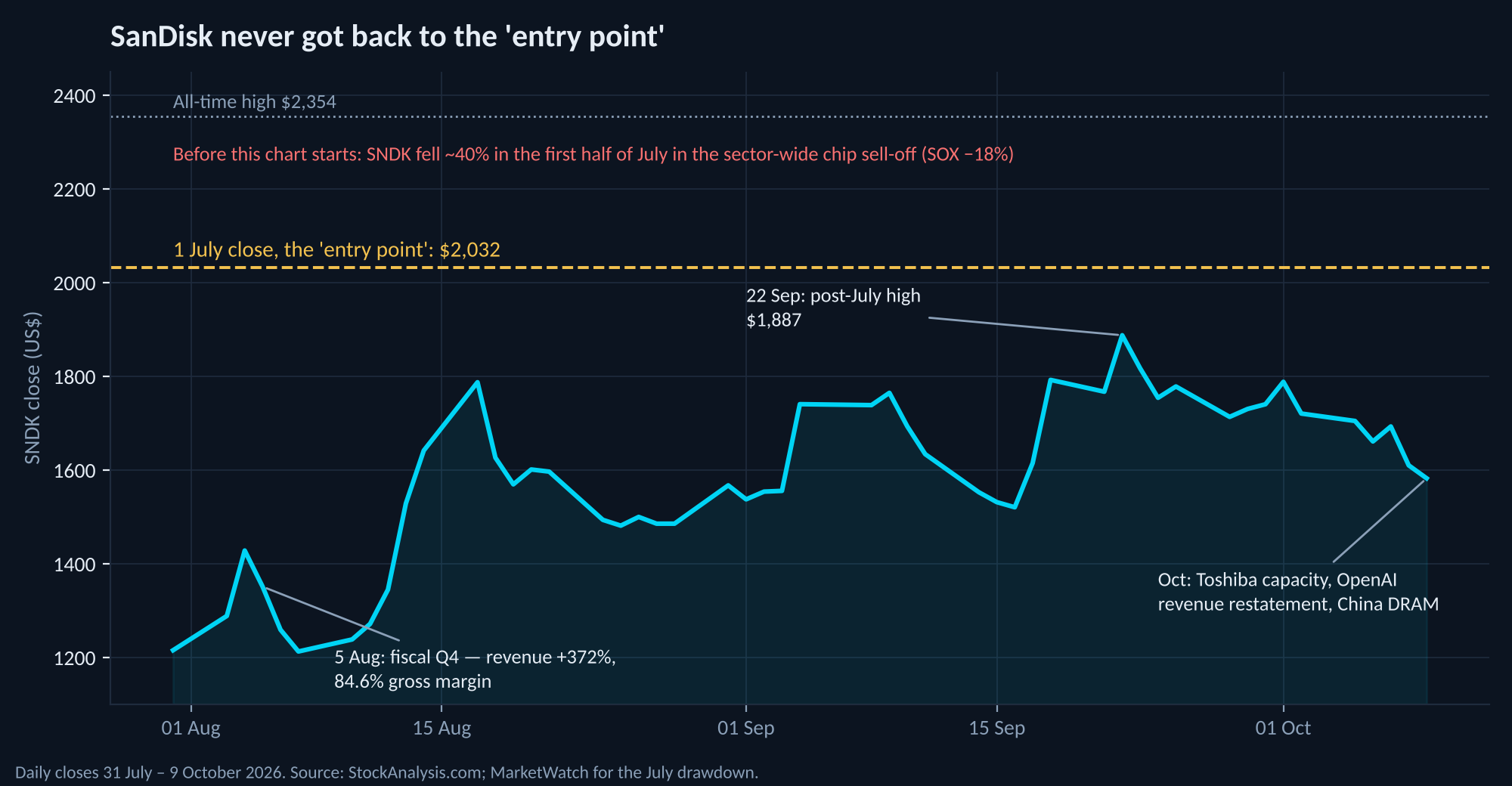
SanDisk's daily closes since the end of July. Even after one of the best quarters any memory company has ever reported, the stock never regained the level I called an entry point.
That shape matters for anyone who acted on the July piece, because the outcome depended entirely on timing. Someone who bought at the 1 July close is down 22% on SanDisk. Someone who bought on 17 July, after the panic, is up. I did not call the bottom; I called the top of a bounce and labelled it the bottom.
3. The memory names: the thesis was right, and it didn't matter
SanDisk (SNDK): −22.2%
On every operational measure I cited, SanDisk did better than the July piece assumed. Its fiscal fourth quarter, reported on 5 August, delivered revenue of $8.97 billion — up 51% on the previous quarter and 372% on the year — at a gross margin of 84.6%. Datacenter revenue doubled sequentially to $2.98 billion. Fiscal 2026 revenue came to $20.25 billion, up 175%. Guidance for the September quarter was $10.3–10.8 billion at a gross margin of 83–85%, with non-GAAP earnings of $44–46 per share. Those are not the numbers of a business whose pricing power is fading.
And yet the stock is lower. The single number that explains it is the forward price-to-earnings ratio: 11.9 in July, 7.4 now. The market did not doubt the earnings; it decided to pay less for each dollar of them, because it increasingly believes they are cyclical peak earnings rather than a new plateau. Mizuho raised its target to $2,050 last week and the consensus target is now $2,173, but the stock is down 8% in the three sessions before its next results.
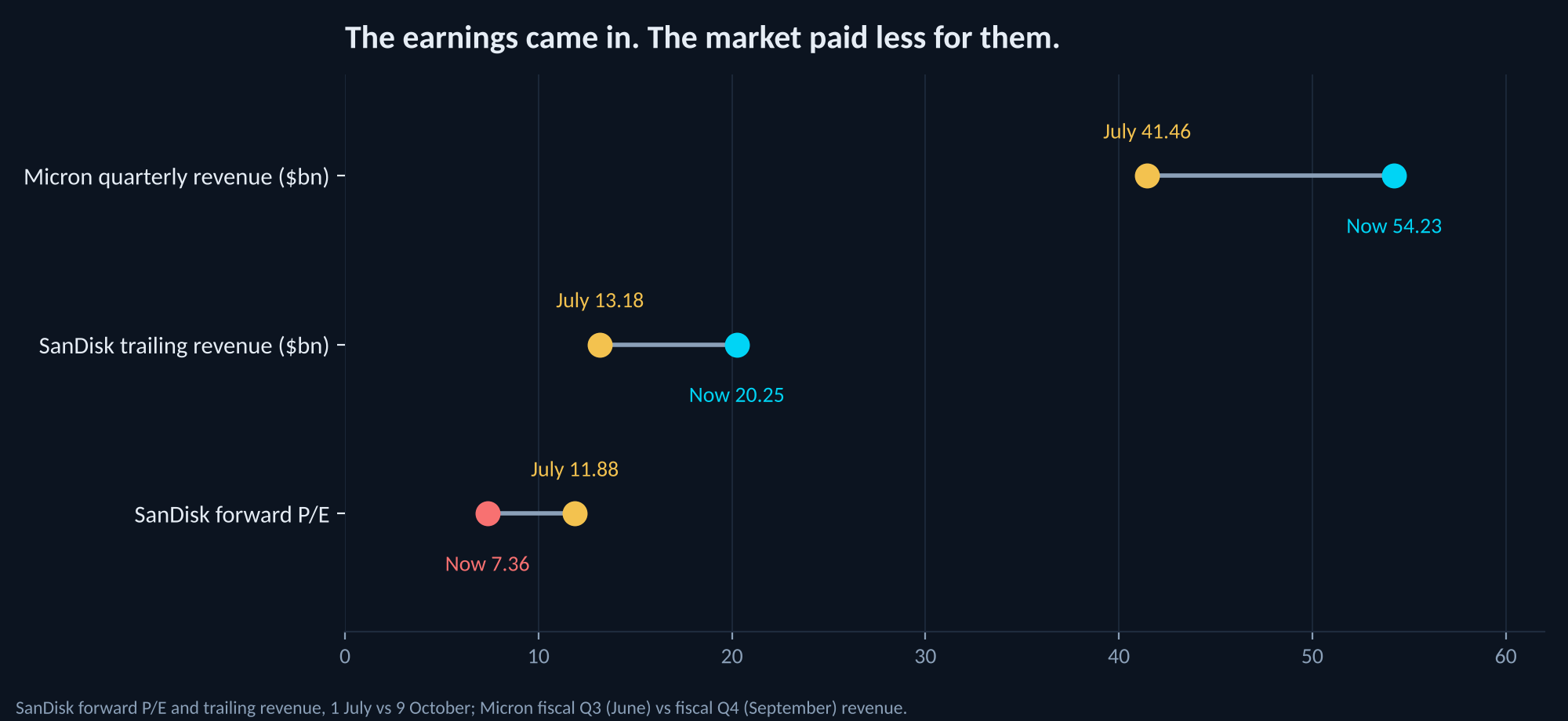
Revenue went up by half. The multiple the market was willing to pay for it went down by more than a third.
Western Digital (WDC): −33.6%
Western Digital is the worst result in the group, and it is now roughly 50% below its June all-time high — a bear market by any definition. Its fiscal fourth quarter, reported on 5 August, was again strong: revenue of $3.75 billion, up 44%, a gross margin of 54.4%, blended price per terabyte up in the high teens year on year while cost per terabyte fell about 8%, and 89% of revenue from cloud customers on long-term agreements, one of which runs through 2029. Guidance for the September quarter is $4.1 billion at a 55–56% gross margin. Trailing net income is now $9.29 billion, up 399%.
What broke the stock was not Western Digital's own news. On 2 October Nikkei reported that Toshiba will spend about $400 million to double its hard-drive capacity by fiscal 2027, aimed at AI storage demand. Western Digital and Seagate each fell more than 10% that day. Toshiba has roughly 17% of the hard-drive market against more than 40% each for the two leaders; doubling its output could take it to something like 30%, and a company filling new capacity has an obvious incentive to win share on price. Morgan Stanley and Citi both said they would buy the dip; UBS cut its target this morning to $470 with a Neutral rating.
I flagged this exact mechanism in July. Fox Advisors had downgraded the stock on the argument that hard-drive pricing expectations "may be getting ahead" of what was realistic, and I wrote that this was "a reasonable caution." It was more than that: it was the story.
Micron (MU): −0.3%
Micron is the clearest illustration of the gap between business and stock. Fiscal fourth-quarter revenue, reported on 30 September, was $54.23 billion — up from $41.46 billion the quarter before and $11.32 billion a year earlier — at a GAAP gross margin of 86.8%, with earnings of $32.87 per share. Fiscal 2026 revenue was $133.19 billion against $37.38 billion the year before. Guidance for the December quarter is about $61.5 billion. The stock trades at under six times forward earnings, has a Strong Buy consensus from 49 analysts, and is exactly where it was on 1 July.
The reasons are the same as SanDisk's, with two additions. Micron is the most exposed of the US names to the Chinese DRAM build-out that CXMT's listing put a valuation on. And labour has become a supply-side variable: unions at Micron's Taiwan operations, which produce about 60% of its output including much of its HBM, have threatened industrial action over bonuses, and the Samsung strike threat earlier in the year briefly lifted the whole group. A strike tightens supply in the short run and is bullish for prices; the market has not decided how to price it.
FormFactor (FORM): −8.4%
FormFactor did what I hoped. Second-quarter results on 29 July were a record, with earnings of $0.82 per share against $0.61 expected, and guidance for about $270 million of third-quarter revenue. Deutsche Bank initiated with a Buy and a $200 target in late September, and the company moved up from the S&P 600 to the S&P 400. It has still drifted lower, with two analysts cutting targets in August. Its pullback is the shallowest of the four memory-linked names, which is roughly what the July piece predicted for the most "picks and shovels" company in the group — but shallow is still negative.
Across the four memory-linked names the average change is −16%.
4. The rest of the stack
NVIDIA (NVDA): +16.0%
In July I called NVIDIA priced for perfection and noted that it had been "trailing chip rivals" all year. Then it delivered something close to perfection. Second-quarter fiscal 2027 revenue, reported on 26 August, was $96.2 billion, up 106%, with data-centre revenue of $89.0 billion and net income of $59.7 billion; guidance for the current quarter is about $108 billion. The stock set an all-time high of $243.37 and is now within reach of a $6 trillion market value. The lesson I take from it is uncomfortable: the "already priced in" argument was a reason I underweighted the company whose earnings were least exposed to the commodity cycle. NVIDIA sells a product with no close substitute; memory makers sell a product whose price is set by the next fab to come online.
The bears have not gone away. Michael Burry added to his NVIDIA puts on 11 August, along with shorts on Palantir, Oracle and the iShares Semiconductor ETF, comparing the off-balance-sheet financing around AI infrastructure to the mortgage market in 2005.
Apple (AAPL): +14.4%
Apple is the other surprise, and the most instructive. I described it as the customer being squeezed by its suppliers, and that is exactly what happened operationally: on its 30 July call Tim Cook repeated the "hundred-year flood" description of memory pricing, said memory costs would rise again in the September quarter, and attributed more than the whole sequential fall in gross margin to them. The iPhone 18 Pro launched at $1,199, $100 above its predecessor. And on 9 October Nikkei reported that Apple has cut iPhone 18 Pro component orders by about 15% because higher prices are weighing on demand.
The stock is up 14% anyway, because the June quarter was strong — revenue of $109.4 billion and services up 12% — and because investors treat Apple as a quality compounder that can pass costs on. It is the one name where the price is now above the average analyst target. A squeezed customer with pricing power turned out to be a better three-month holding than its suppliers with pricing power.
TSMC (TSM): +1.8%
TSMC did everything the July piece expected. Third-quarter revenue was a record NT$1.49 trillion, up 50%, ahead of both its own guidance and the analyst consensus, and September revenue alone was up 54.6%. It reports full results this Thursday, 15 October. The stock is barely changed, and the consensus target has risen by almost a fifth, to $578. It remains the name I find hardest to argue against on the July logic: every advanced AI chip still goes through it, and there are reports that it may help operate the Terafab plants Elon Musk is planning in Texas.
Texas Instruments (TXN): −0.6%
Texas Instruments is flat, and its business is quietly doing what I said it would. Second-quarter revenue rose 23% to $5.5 billion, data-centre revenue doubled year on year, guidance for the third quarter came in above seasonal, and the company raised its dividend by 7% in September. Management said the analog price increases I mentioned in July are only starting to show up, with most of the effect in the fourth quarter and next year. It reports on 21 October.
Intel (INTC): −17.6%
Intel was the name I flagged as a turnaround bet layered on top of an AI bet, and the turnaround side dominated. Second-quarter revenue rose 25% to $16.1 billion and non-GAAP earnings were $0.42 a share, but the GAAP loss was $11.0 billion, about $12.5 billion of it a mark-to-market charge on shares escrowed under the US government agreement, and the foundry business lost another $2.1 billion. The consensus has actually moved from Hold to Buy and the average target from $98.50 to $118, but the stock has given back most of its June spike. Its role in Musk's Terafab project, which chief executive Lip-Bu Tan reaffirmed last week, is now the main swing factor in the story.
5. What I got wrong, specifically
It would be easy to write this up as "the market was irrational." I don't think it was. I think the July piece made three errors, and two of them were sitting in its own risks section.
I treated the shortage as the thesis, when the stocks were pricing the end of the shortage. Everything I cited in July — memory contract prices, earnings growth, low forward multiples — was evidence that the shortage was real. None of it was evidence about when it would end, which is what the share prices of cyclical companies are actually about. A forward P/E of 12 on SanDisk was not a sign of cheapness; it was the market telling me it expected the earnings to fall. That multiple is now 7.4, which is the same message, louder.
I wrote the supply-response risk and then discounted it. The July piece said, in so many words, that "nothing about physics prevents" the boom-bust pattern from repeating "once the current wave of fab investment matures into shipped wafers." I then said none of it changed "the near-term picture." In the three months since, the market got two concrete supply signals: CXMT's listing, which put a $480-billion-plus valuation on a Chinese DRAM competitor and the capital that comes with it, and Toshiba's plan to double its hard-drive capacity. Neither adds supply this quarter. Both moved the date at which the market expects prices to turn, and that date is what these stocks trade on.
I confused the picks-and-shovels argument with the commodity argument. The gold-rush lens says the suppliers win. But the July piece's own closing paragraph noted that the analogy favoured the toll-takers — TSMC, FormFactor — over the commodity memory makers. The three months since have favoured something else again: the companies whose products have no substitute (NVIDIA) and the companies with brand pricing power (Apple), over the companies selling a product whose price is set at the margin. Memory is a pick and a shovel. It is also a commodity, and commodities are priced on the next unit of supply.
There is one more, which is about tone rather than analysis. In July I wrote that I was confident enough in the call to offer to help readers act on it. Three months later, someone who did would be down on the two names I was most enthusiastic about. That is the strongest argument I know for writing pieces like this one, and for the disclaimer that follows every one of them.
6. What is still true
None of the above means the AI hardware cycle has turned. Several things from July are not just intact but stronger.
Memory prices are still rising. TrendForce's latest forecast, published on 30 September, has conventional DRAM contract prices up another 10–15% in the fourth quarter and NAND up 15–20%, the latter accelerating as enterprise SSD demand grows. That is a slower rate of increase for DRAM than the 58–63% of the second quarter, but it is still an increase. Inventories remain historically low, and suppliers are still prioritising HBM and server memory over conventional products.
The demand side is still compounding. NVIDIA guided to $108 billion for this quarter; TSMC's September revenue was up 55%; Micron is guiding to $61.5 billion. None of those is a demand signal that is rolling over.
The earnings are not hypothetical. SanDisk at 7.4 times forward earnings and Micron at under six are pricing a large fall in profits. If the downturn comes later or more gently than that implies, the multiples have a long way to rise. If it comes soon and hard, they are not as cheap as they look.
But the demand side has a new fragility. On 8 October, OpenAI told prospective investors that its annualised revenue was about $50 billion, against the $68 billion it had cited in August — a difference the company attributed to counting net rather than gross revenue. The Nasdaq had its worst day since mid-August; Oracle fell 5.5% and CoreWeave 8%. Talk of delayed AI listings has been weighing on the group since June. The memory trade is ultimately a bet that the companies buying the chips can keep paying for them, and that bet now has public price tags attached.
7. What I am watching next
The next three weeks will tell us more than the last three months.
| Date | Event | What would matter |
|---|---|---|
| 15 Oct | TSMC Q3 results | Capex guidance and the fourth-quarter AI revenue outlook; any comment on Terafab |
| 21 Oct | Texas Instruments Q3 | Whether analog price increases show up in the fourth-quarter guide |
| 22 Oct | Western Digital FQ1 2027 | Gross margin against the 55–56% guide; a print below 55% would be the first sign that pricing is softening |
| 28 Oct | FormFactor Q3 | HBM4 probe-card demand against the ~$270 million guide |
| 29 Oct | Intel Q3 | Foundry losses, and anything concrete on Terafab or external 18A customers |
| Late Oct | Apple FQ4 and SanDisk FQ1 | Apple on iPhone 18 demand and memory costs; SanDisk on whether the $10.3–10.8 billion guide holds |
| Nov | NVIDIA Q3 FY27 | Delivery against the $108 billion guide |
| Ongoing | CXMT output, Toshiba's ramp, Micron Taiwan labour talks, the DRAM price-fixing suit | The supply side, which is now what the memory stocks are trading on |
The signposts I would weight most heavily for the memory names are on the supply side: Western Digital's gross margin, any sign of DRAM contract prices flattening in TrendForce's December update, and how quickly CXMT and Toshiba actually ship. The demand side has been confirmed three times over. The question was always when the supply would catch up, and that is the question I did not answer in July.
8. Where I land now
In July I wrote that "which specific company, at which valuation, with which risk profile, is the actual question." I still think that is right, and I would now answer it differently.
I would separate the industry thesis from the stock thesis. The industry thesis — that AI infrastructure has created a shortage of memory and storage, and that the companies supplying it are earning extraordinary profits — has been confirmed by every quarter since. The stock thesis — that those profits will be valued as if they were durable — has not been, and the market has spent three months telling me it does not believe it. I should have given that disagreement more weight in July, because the market had seen every cycle these companies have been through, and I was writing about the first one in which they had been this profitable.
I would also take the three months as evidence for the less glamorous names in the July piece. The companies whose position does not depend on the next fab — TSMC, which every advanced chip passes through, Texas Instruments, whose analog price increases are only beginning, and NVIDIA, which I was too quick to call fully priced — held up. The ones whose margins depend on the timing of the next supply wave did not.
And I would size anything in the memory names as what it is: a bet on the timing of a commodity cycle, made against a market that is pricing a downturn. That bet may yet pay. Seven times earnings is a low price for a company still guiding to higher revenue. But it is a different bet from the one I described in July, and anyone who acted on the July piece deserves to have that said plainly.
This article is a research and educational summary and does not constitute investment advice, and I am not a licensed financial advisor. It is not a recommendation to buy or sell any security. Readers should consult a licensed financial advisor and do their own due diligence before making investment decisions. Past performance, including the moves described here in both directions, is not indicative of future results.
References and Further Reading
Prices, fundamentals and consensus targets - StockAnalysis.com — SNDK, WDC, MU, NVDA, TSM, INTC, FORM, TXN, AAPL, SMH — closing prices to 9 October 2026, forward P/E, analyst consensus
Company results - Sandisk — Fiscal fourth quarter 2026 financial results, 5 August 2026 - Micron — Record fiscal Q4 revenue of $54.23 billion, 30 September 2026 - Trefis — What changed for Western Digital stock, and what did not?, 5 October 2026 (fiscal Q4 results and guidance) - NVIDIA — Q2 fiscal 2027 results, 26 August 2026 - Intel — Second-quarter 2026 financial results, July 2026 - Texas Instruments — Q2 2026 earnings call highlights, July 2026 - Apple — Q3 earnings call: supply constraints, memory costs, 30 July 2026 - KSL / Reuters — TSMC's third-quarter revenue surges to record, 8 October 2026
Market events - MarketWatch via Morningstar — 19 (mostly) tech stocks that have fallen at least 25% in July, 17 July 2026 - Tiger / Dow Jones — Micron and other chip stocks fall as China steals the spotlight (CXMT listing), 28 July 2026 - Motley Fool — Why Western Digital stock just crashed (Toshiba expansion), 2 October 2026 - Fox / Reuters — Apple cuts iPhone 18 Pro orders over weak sales, 9 October 2026 - Techzine — OpenAI's revenue figures cause turmoil on the stock market, 9 October 2026 - MarketBeat — Chip stocks slide again as AI's IPO doubts pile up, 29 June 2026 - Stocktwits — Michael Burry adds to NVDA, PLTR, ORCL shorts, August 2026 - Guru3D — Micron Taiwan workers move toward possible strike, 31 August 2026 - The Next Web — Intel will stay on Musk's Terafab chip project, 7 October 2026
Memory pricing - NextMSC — DRAM and NAND price tracker, October 2026 (TrendForce Q3 and Q4 2026 contract price forecasts)
The original piece - Investing in the AI Boom, 2 July 2026